
Bradford County Court Records After a Jail Arrest
After an arrest in Bradford County, two records exist side by side for the same person. The booking record at the jail lists the charges a deputy wrote at intake. The court record begins later, when the State Attorney reviews the case and files a charging document. That filing is what opens the case and becomes the official court record. The two can differ, because the prosecutor may file, amend, reduce, or decline the charges that the arrest started with.
For the booking and custody side, the jail inmate records page covers the roster, and the jail mugshots page covers booking photos. This page stays on the court records that follow a Bradford County arrest: where the case lives, how the charges are filed, what the charge status means, and how an arrest record can later be sealed or expunged. Bradford County is served by the Clerk of the Circuit Court and the Eighth Judicial Circuit State Attorney.
Find Bradford County Court Records After Arrest
Bradford County court charges and case events live with the Clerk of Court, not on the jail roster. The clerk offers an online case-record search through the Civitek Florida Online Court Records Search (OCRS) for Bradford County. The access page, shown below, lists the public option plus attorney, registered-user, and party logins.
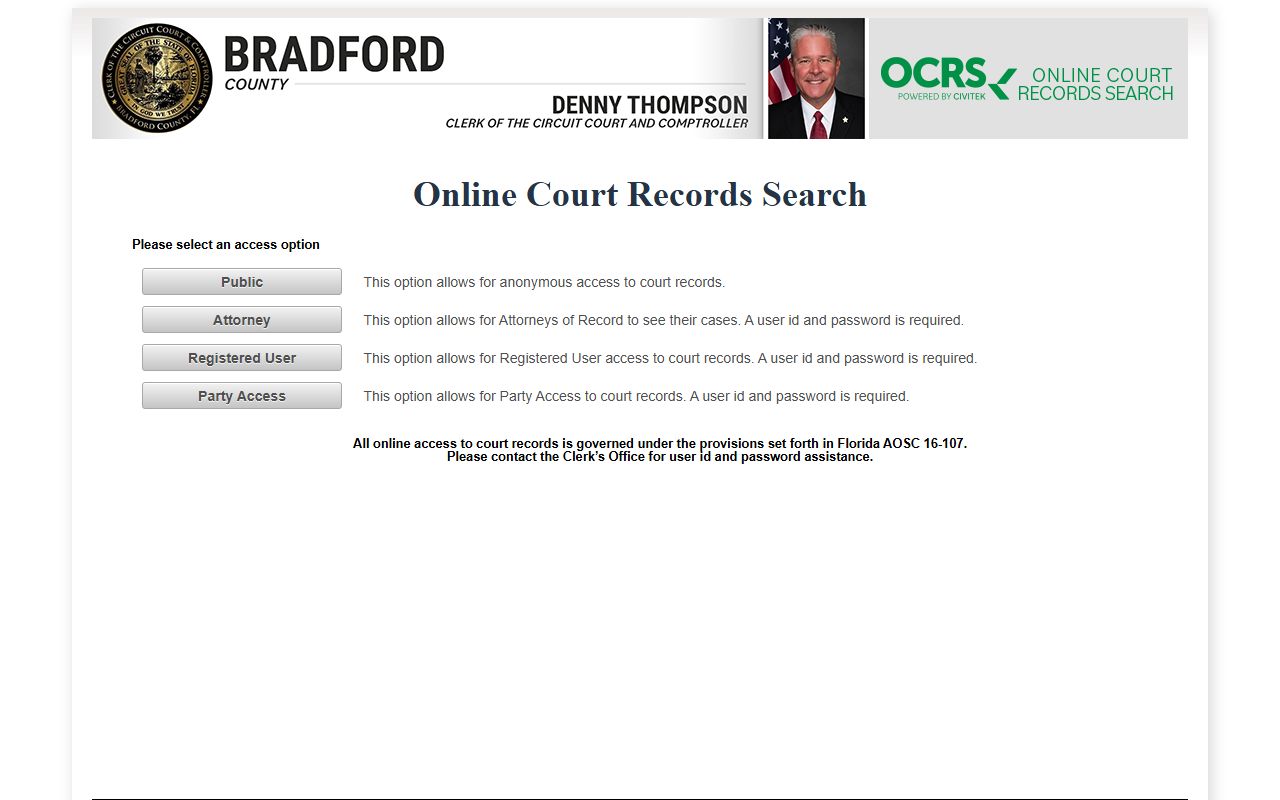
The public option allows anonymous access; the login roles are for attorneys and parties to a case. The table breaks the options down.
| Option | Login | Notes |
|---|---|---|
| Public | No login | Anonymous access to available court records. |
| Attorney | User ID and password | Attorneys of record. |
| Registered User | User ID and password | Expanded access under a signed agreement. |
| Party Access | User ID and password | For a party to the case. |
All online access is governed by Florida court rule AOSC 16-107. Use these steps to find a case.
- Open the Bradford County OCRS page from the Clerk of Court site.
- Choose Public access, or log in if you are an attorney or party.
- Search by the defendant's name, or by the case number if the jail roster gave you one.
- Open the case and read the charge list, then check each charge's code, level, and current status.
Statewide criminal history is a separate matter. Florida criminal-history records are public unless sealed or expunged, and a person can review their own record through the Florida Department of Law Enforcement.
Bradford County Charges Filed After an Arrest
The booking happens at the Bradford County jail, but the charge record starts when the prosecutor files a charging document. In Florida the prosecutor is the State Attorney, not a district attorney. Bradford County falls under the Eighth Judicial Circuit, which also covers Alachua, Baker, Gilchrist, Levy, and Union counties. After an arrest the State Attorney can file by complaint, by information, or, for grand-jury matters, by indictment. The table shows the three types.
| Complaint | Information | Indictment | |
|---|---|---|---|
| Filed By | Officer / Prosecutor | State Attorney | Grand Jury |
| Common For | Misdemeanors | Many felonies | Serious felonies |
| Starts | The case | The case | The case |
The State Attorney decides which charges to pursue and may divert eligible cases to drug, mental-health, or deferred-prosecution tracks. That is why an arrest does not always lead to the same filed charge, and why the court record is the place to confirm what the state actually charged.
Bradford County Charge Status Explained
Charges change as a Bradford County case moves. The booking charge on the jail roster can be amended, reduced, added to, dropped, or dismissed once the case is in court. Reading the status terms keeps the record clear. The table defines the ones you will see most.
| Status | What It Means |
|---|---|
| Pending | The case is open and the charge has not been resolved. |
| Amended / Reduced | The prosecutor changed the charge, often to a lesser offense. |
| Dismissed | The court dropped the charge; it is no longer being pursued. |
| Nolle Prosequi | The prosecutor chose not to proceed on the charge. |
Certified Bradford County Court Records
An online search lets you read a Bradford County case, but a certified copy comes from the clerk. The clerk's eCertify process, shown below, walks a buyer from the case number to a paid, certified document.
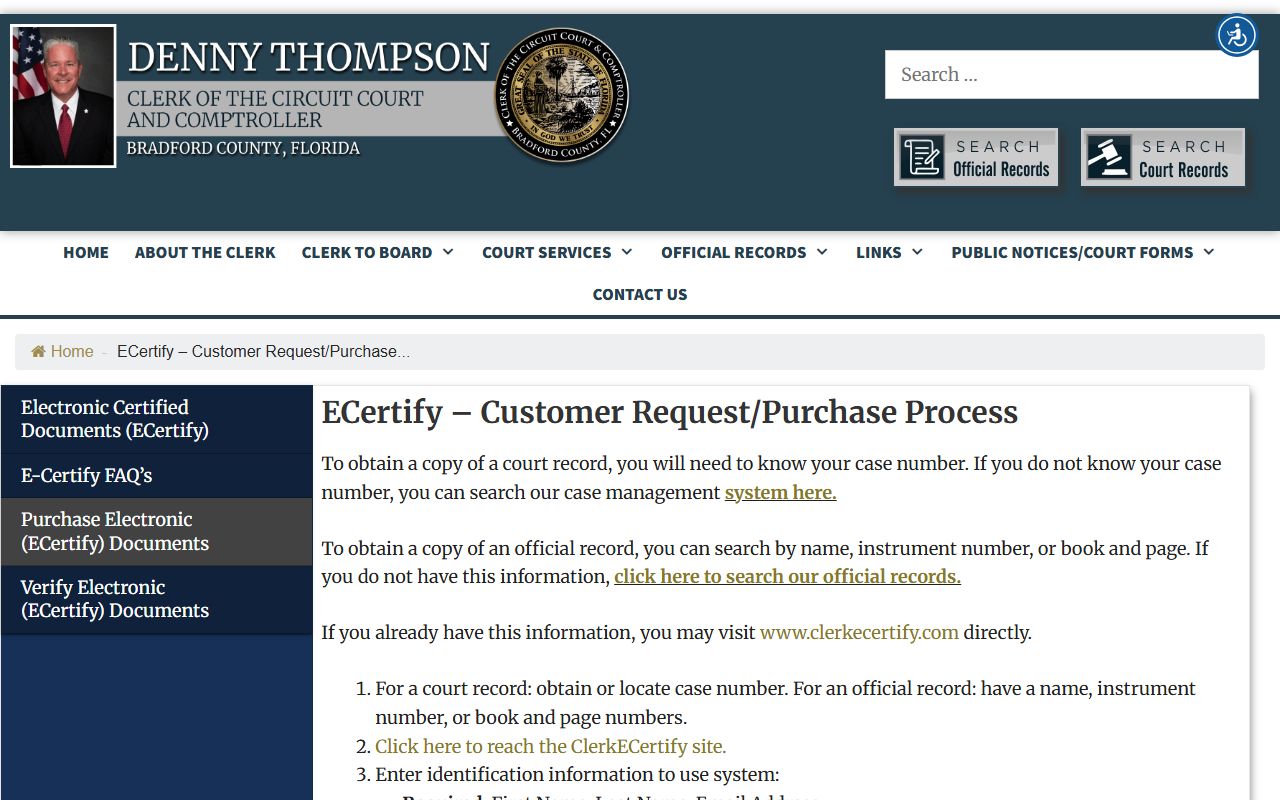
To buy a court copy you first need the case number, which you can find through OCRS, then use ClerkECertify and enter the local or uniform case number. If a document is not yet available, the clerk can request its release, which may take up to 72 hours. Clerk fees include $1.00 per page for a court public-record copy, $2.00 per document to certify, and $2.00 for each year searched. Sealing or expunging a court file carries a $42.00 charge. The clerk switchboard is 904.966.6280, and the felony division is 904.966.6255.
Bradford County Bond and Release After Arrest
Bond is set around first appearance in Bradford County, a hearing held daily about 10:00 a.m. in Bradford County. The sheriff warns that a bond amount is often not posted until the judge's written order reaches jail staff, so a roster can read "NO BOND" simply because the order has not arrived. Holds from another agency can keep a person in custody even when a local charge is bondable. The table covers the main bond types.
| Bond Type | How It Works |
|---|---|
| Cash Bond | The full court-set amount is paid to secure release. |
| Surety Bond | A licensed bail bond agent posts the bond for a fee. |
| PR / Own Recognizance | Release without cash, on a promise to appear and court conditions. |
| No-Bond Hold | No set amount allows release, often due to a violation, warrant, or hold. |
Court-set bond money is handled through the clerk and court financial rules, not the jail roster. The clerk's fee schedule lists a bond-approving charge of $8.50 among its service fees.
Bradford County Warrants and Arrests
Many Bradford County arrests start with a warrant. The Bradford County Sheriff's Office runs an online warrant search, reached from its warrant-search page, shown below. The page warns plainly not to try to detain anyone and to call the sheriff at 904.966.6161 with information.
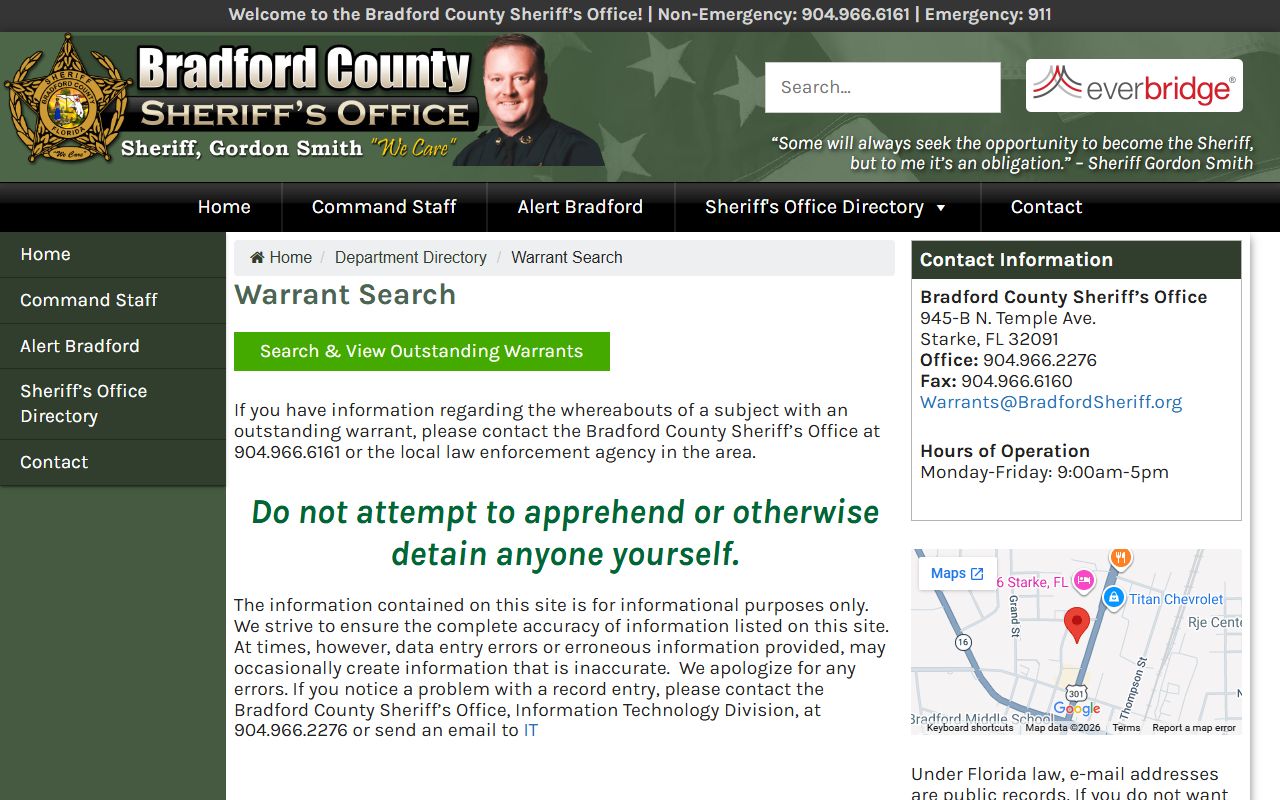
The warrant search runs by first, middle, and last name through SmartWeb. Bench warrants, which come from a missed court event, may instead show up in the case docket through OCRS. When a warrant leads to a booking, the jail roster can list a related hold or charge, tying the warrant back to the court case.
The State Attorney's Role After an Arrest
The Eighth Judicial Circuit State Attorney is the office that turns an arrest into a court case. It reviews the arrest, decides the formal charges, and prosecutes them. The same office runs the seal and expunge guidance and handles victim services. For Bradford County, the circuit lists a local victim advocate reachable at 904.966.6227, while the administrative victim-services line for the circuit is 352.374.3627.
Victim notification is separate from a public case lookup. The jail links victims to VINELink for release alerts, while the State Attorney handles victim rights and case updates. A reader checking on a case should know that the prosecutor, not the arresting deputy, controls the charges once the case is filed, and that the office can amend or drop a charge as the case develops.
Bradford County Booking Charge to Court Case
The fastest bridge from an arrest to the court record is the case number. The jail roster's charge table can list a court case number next to a charge, in a form like 25CF422, along with the booking agency. Copy that number, the booking date, and the name, then search OCRS by case number for a clean match. If the roster shows no case number yet, search the clerk's system by the defendant's name instead. Compare the roster charge to the court docket, because the arrest charge and the filed charge are often not identical.
Charges vs. Convictions
Being arrested and charged in Bradford County is not the same as being convicted. A charge is an accusation; a conviction is the result of a plea or verdict. Both are public, but they mean very different things.
| Charge | Conviction | |
|---|---|---|
| Stage | Accusation | Verdict or plea |
| Burden of Proof | Probable cause | Beyond a reasonable doubt |
| Public Record | Yes | Yes |
Sealed vs. Expunged Bradford Arrest Records
After a dismissal or an eligible disposition, a person may seal or expunge a Florida record. The Eighth Circuit State Attorney publishes a step-by-step guide and points applicants to the Florida Department of Law Enforcement for a certificate of eligibility. The process runs through FDLE and the court, and the State Attorney may agree, disagree, or take no position. The table shows the difference.
| Sealed | Expunged | |
|---|---|---|
| Visibility | Hidden from public view | Destroyed or treated as never existing |
| Law Enforcement | Limited access | Very limited access |
| Eligibility | Court-ordered sealing under Florida Statutes § 943.059 | Court-ordered expunction under Florida Statutes § 943.0585 |
The path starts with the FDLE Application for Certification of Eligibility, signed under oath, then a petition filed with the clerk in the county where the matter occurred. A $42.00 clerk charge applies to sealing or expunging the court file, and FDLE charges a separate fee. Even after a court order, a person should not assume every copy on every outside system disappears on its own.
Restricted Bradford County Court Records
Not every Bradford County court record after an arrest is open. Florida law exempts or confidentializes certain categories, and the clerk may limit what is viewable online. Juvenile matters, sealed or expunged charges, and active investigations are common examples. Florida Statutes § 119.0714 governs exemptions for court files and records, while § 119.071 lists broader law-enforcement exemptions that can require redaction.
Online viewing is also tiered on purpose. The public OCRS option shows what court rule allows, while attorneys and parties sign an agreement for expanded access under a unique login. The clerk can hold back documents flagged as confidential and notes that access may pause for maintenance or security. If a document does not show online, request it through the clerk by the case number, or visit the courthouse at 945 North Temple Avenue in Starke. Mail goes to the Clerk of the Court, P.O. Drawer B, Starke, FL 32091.
Important: This is a private reference site and not a consumer reporting agency under the FCRA, so court records found here cannot be used for hiring, housing, credit, or insurance screening.